And here is the Wannaskan Almanac with Word-Wednesday for October 21, 2026, the forty-second Wednesday of the year, the fifth Wednesday of fall, the third Wednesday of October, and the two-hundred ninty-fourth day of the year, with seventy-one days remaining.
Wannaska Phenology Update for October 21, 2026
Tamaracks Turning
Larix laricina, commonly known as the tamarack, hackmatack, eastern larch, black larch, red larch, or American larch, is a species of larch native to Canada, from eastern Yukon and Inuvik, Northwest Territories east to Newfoundland, and also south into the upper northeastern United States from Minnesota to Cranesville Swamp, West Virginia. There is also an isolated population in central Alaska. The Anishinaabe word for tamarack is mashkiigwaatig /mash-KEE-gwah-tig/.
A boreal deciduous conifer tree common to low-land areas such as swamps, fens, and bogs, reaching seventy-five feet tall, with a trunk up to twenty-four inches in diameter. The tamarack leaves are needle-like, one inch long, and light blue-green, produced on long woody spur shoots in groups of ten to twenty. Prior to falling off in the autumn, the leaves turn bright yellow, leaving the shoots bare until the next spring.
The wood is tough and durable, but also flexible in thin strips. It was used by the native people for making snowshoes and other products where toughness was required. The natural crooks located in the stumps and roots are also preferred for creating knees in wooden boats.

October 21 Fickle Pickle Wednesday Menu Special: Potato Dumpling
October 21 Nordhem Wednesday Lunch: Still closed until further notice.
Earth/Moon Almanac for October 21, 2026
Sunrise: 7:53am; Sunset: 6:23pm; 3 minutes, 25 seconds less daylight today
Moonrise: 4:30pm; Moonset: 2:22am, waxing gibbous, 72% illuminated.
Temperature Almanac for October 21, 2026
Average Record Today
High 30 78 61
Low 7 -2 33
Poem in October
by Dylan Thomas
It was my thirtieth year to heaven
Woke to my hearing from harbour and neighbour wood
And the mussel pooled and the heron
Priested shore
The morning beckon
With water praying and call of seagull and rook
And the knock of sailing boats on the net webbed wall
Myself to set foot
That second
In the still sleeping town and set forth.
My birthday began with the water-
Birds and the birds of the winged trees flying my name
Above the farms and the white horses
And I rose
In rainy autumn
And walked abroad in a shower of all my days.
High tide and the heron dived when I took the road
Over the border
And the gates
Of the town closed as the town awoke.
A springful of larks in a rolling
Cloud and the roadside bushes brimming with whistling
Blackbirds and the sun of October
Summery
On the hill's shoulder,
Here were fond climates and sweet singers suddenly
Come in the morning where I wandered and listened
To the rain wringing
Wind blow cold
In the wood faraway under me.
Pale rain over the dwindling harbour
And over the sea wet church the size of a snail
With its horns through mist and the castle
Brown as owls
But all the gardens
Of spring and summer were blooming in the tall tales
Beyond the border and under the lark full cloud.
There could I marvel
My birthday
Away but the weather turned around.
It turned away from the blithe country
And down the other air and the blue altered sky
Streamed again a wonder of summer
With apples
Pears and red currants
And I saw in the turning so clearly a child's
Forgotten mornings when he walked with his mother
Through the parables
Of sun light
And the legends of the green chapels
And the twice told fields of infancy
That his tears burned my cheeks and his heart moved in mine.
These were the woods the river and sea
Where a boy
In the listening
Summertime of the dead whispered the truth of his joy
To the trees and the stones and the fish in the tide.
And the mystery
Sang alive
Still in the water and singingbirds.
And there could I marvel my birthday
Away but the weather turned around. And the true
Joy of the long dead child sang burning
In the sun.
It was my thirtieth
Year to heaven stood there then in the summer noon
Though the town below lay leaved with October blood.
O may my heart's truth
Still be sung
On this high hill in a year's turning.
October 21 Celebrations from National Day Calendar
- Back to the Future Day
- National Reptile Awareness Day
- National Pumpkin Cheesecake Day
- National Apple Day
- National Witch Hazel Day
- Hagfish Day
- Bra Day
- Medical Assistants Recognition Day
- Feast Day of Fintán of Taghmon
October 21 Word Pun

October 21 Word Riddle
What shivers at the bottom of the ocean?*
October 21 The Devil’s Dictionary Word-Pram
HEATHEN, n., A benighted creature who has the folly to worship something that he can see and feel. According to Professor Howison, of the California State University, Hebrews are heathens.
"The Hebrews are heathens!" says Howison. He's
A Christian philosopher. I'm
A scurril agnostical chap, if you please,
Addicted too much to the crime
Of religious discussion in rhyme.
Though Hebrew and Howison cannot agree
On a modus vivendi—not they!—
Yet Heaven has had the designing of me,
And I haven't been reared in a way
To joy in the thick of the fray.
For this of my creed is the soul and the gist,
And the truth of it I aver:
Who differs from me in his faith is an 'ist,
An 'ite, an 'ic, or an 'er—
And I'm down upon him or her!
Let Howison urge with perfunctory chin
Toleration—that's all very well,
But a roast is "nuts" to his nostril thin,
And he's running—I know by the smell—
A secret and personal Hell!
—Bissell Gip
October 21 Etymology Word of the Week
queue
/kyo͞o/ n., a line, sequence, or ordered list of people, vehicles, objects, or computer tasks waiting for their turn, from late 15th century, "band attached to a letter with seals dangling on the free end," from French queue "a tail," from Old French cue, coe, queue, "tail" (12th century, also "penis"), from Latin coda (dialectal variant or alternative form of cauda) "tail".
Also in literal use in 16th century English, "tail of a beast," especially in heraldry. A metaphoric extension to "line of dancers" (circa 1500) perhaps led to the extended sense of "line of people, etc." (1837), but this use in English is perhaps directly from French (queue à queue, "one after another" appears in early 19th century English and American military dictionaries).
If we look now at Paris one thing is too evident: that the Baker's shops have got their Queues, or Tails; their long strings of purchasers arranged in tail, so that the first come be the first served,—were the shop once open! This waiting in tail, not seen since the early days of July, again makes its appearance in August. In time, we shall see it perfected, by practice to the rank almost of an art ; and the art, or quasi-art, of standing in tail become one of the characteristics of the Parisian People, distinguishing them from all other Peoples whatsoever. [Carlyle, The French Revolution, 1837]
Churchill is said to have coined Queuetopia (1950), to describe Britain under Labour or Socialist government.
Also used 18th century in sense of "braid of hair hanging down behind" (attested by 1748), originally part of the wig, in later 18th century of the hair of the head.
QUEUE. From the French, which signifies tail; an appendage that every British soldier is directed to wear in lieu of a club. Regimental tails were ordered be nine inches long. [William Duane, A Military Dictionary, Philadelphia, 1810]
Don't forget to queue-up and vote.
October 21 Historic Events, Literary or Otherwise, from On This Day
- 1512 Martin Luther joins the theological faculty of the University of Wittenberg.
- 1803 English scientist John Dalton reads his paper, On the Absorption of Gases by Water and Other Liquids, to the Manchester Literary and Philosophical Society, outlining his atomic theory.
- 1854 Florence Nightingale, with a staff of 38 nurses, is sent to the Crimean War.
- 1858 Jacques Offenbach's operetta Orpheus in the Underworld (Orphée aux Enfers) premieres.
- 1925 Sidney Howard's Lucky Sam McGarver premieres.
- 1940 The first edition of the Ernest Hemingway novel For Whom the Bell Tolls is published.
- 1944 Walter Piston's Fugue on a Victory Tune premieres.
- 1945 Women in France are allowed to vote for the first time.
- 1949 Aldous Huxley, author of Brave New World, writes to congratulate George Orwell on his new novel Nineteen Eighty-Four.
- 1958 First woman in British House of Lords.
- 1959 Guggenheim Museum, designed by Frank Lloyd Wright, opens.
- 1969 Leonard Gersh's Butterflies are Free premieres.
- 1971 Nobel prize in literature is awarded to Pablo Neruda.
- 1976 Nobel Prize in Literature is awarded to American Saul Bellow.
October 21 Author/Artist/Character Birthdays, from On This Day
- 1570 Wolfgang Schonsleder, German composer.
- 1574 Nicolò Rubini, Italian composer and cornettist.
- 1581 Domenichino [Domenico Zampieri], Italian Baroque painter.
- 1680 Francisco José Coutinho, Portuguese composer.
- 1751 David Moritz Michael, Moravian conductor and composer.
- 1772 Samuel Taylor Coleridge, English poet.
- 1790 Alphonse de Lamartine, French writer.
- 1807 Miguel Hilarion Eslava, Spanish composer.
- 1807 Napoléon Henri Reber, French composer.
- 1823 Emilio Arrieta, Spanish opera and zarzuela composer.
- 1827 Peter Paul Maria Alberdingk Thijm, Dutch historian and writer.
- 1843 Mark Antokolsky, Russian sculptor.
- 1846 Edmondo de Amicis, Italian writer.
- 1847 Giuseppe Giacosa, Italian playwright, poet.
- 1879 Joseph Canteloube, French composer.
- 1885 Egon Wellesz, Austrian-British composer.
- 1885 Jan Altink, Dutch Expressionist painter.
- 1890 Gerrit Engelke, German writer and poet.
- 1891 Ted Shawn, American choreographer.
- 1894 Edogawa Ranpo, Japanese author.
- 1895 Shukichi Mitsukuri, Japanese composer.
- 1902 Hilarion Rubio, Filipino composer.
- 1904 Edmond Hamilton, American science fiction author.
- 1904 Patrick Kavanagh, Irish poet.
- 1907 Nikos Engonopoulos, Greek surrealist painter and poet.
- 1908 Howard Ferguson, British-Irish pianist, composer,.
- 1916 Tomojirō Ikenouchi, Japanese composer.
- 1916 Violet Hensley (née Brumley), American fiddler and instrument maker.
- 1916 František Roman Dragoun, Czech painter.
- 1917 John Birks "Dizzy" Gillespie, American jazz trumpeter, a creator of bebop & modern jazz.
- 1919 Claire Sterling, American journalist and writer.
- 1921 Jarmil Burghauser [Mokrý], Czech composer.
- 1921 Malcolm Arnold, English composer.
- 1926 Marga Richter, American classical pianist and composer.
- 1927 Nadia Nerina [Nadine Judd], South African-British ballerina.
- 1928 Yú Guāngzhōng [Yu Kwang-chung], Taiwanese poet.
- 1929 Ursula K. Le Guin, American author.
- 1933 Maureen Duffy, British activist, novelist and playwright.
- 1933 Zdena Salivarova, Czech-Canadian writer.
- 1935 (George) Derek Bell, Irish harpist, pianist, oboist, musicologist, and composer.
- 1936 Simon Gray, British novelist and playwright.
- 1943 Paula Kelly, American dancer, choreographer.
- 1943 Tariq Ali, Pakistani author.
- 1944 Janet Ahlberg, British children's book illustrator.
- 1952 Allen Hoey, American poet and novelist.
- 1963 Bohumír Dvorský, Czech painter.
- 1973 Lera Auerbach, Russian-American pianist, composer, and poet.
- 1983 Aboudia [Abdoulaye Diarrassouba], Ivorian-American artist.
Words-I-Looked-Up-This-Week Writer's Challenge
Write a story or pram from the following words:
- braw: /braa/ adj., SCOTTISH, good, fine, excellent, or handsome.
- cavil: KAV-uhl/ v., to raise petty or unnecessary objections, especially over minor details or trivial matters; also, a noun referring to such an objection.
- dinky: /DING-kee/ n., a small locomotive; adj., overly or unattractively small.
- duenna: /do͞o-EN-ə/ n., an older woman serving as a governess, companion, or chaperone to younger, unmarried women.
- jerrycummumble: /JAIR-ee-kuhm-mum-buhl/ v., to shake or tumble (a person or thing) about; to cause to become jumbled or confused.
- matriot: /MĀ-tree-ot/ n., one who advocates for maternal or nurturing causes such as human rights, universal healthcare, the eradication of poverty; who loves or celebrates the influence of women upon society.
- pizzazz: /pi-zaz/ n., an attractive combination of vitality, style, sparkle, and energetic excitement.
- pouchade: /poh-SHAHD/ n., rough or hastily executed sketch; a blurred or indistinct picture.
- susurrus: /soo-SUR-uhs/ n., a soft, whispering, or rustling sound, especially the gentle murmur of wind moving through leaves, grasses, or other foliage.
- tmesis: /tuh-MEE-suhs/ n., the insertion of a word or phrase between the parts of a compound word or expression, often for emphasis or humorous effect.
October 21, 2026 Word-Wednesday Feature
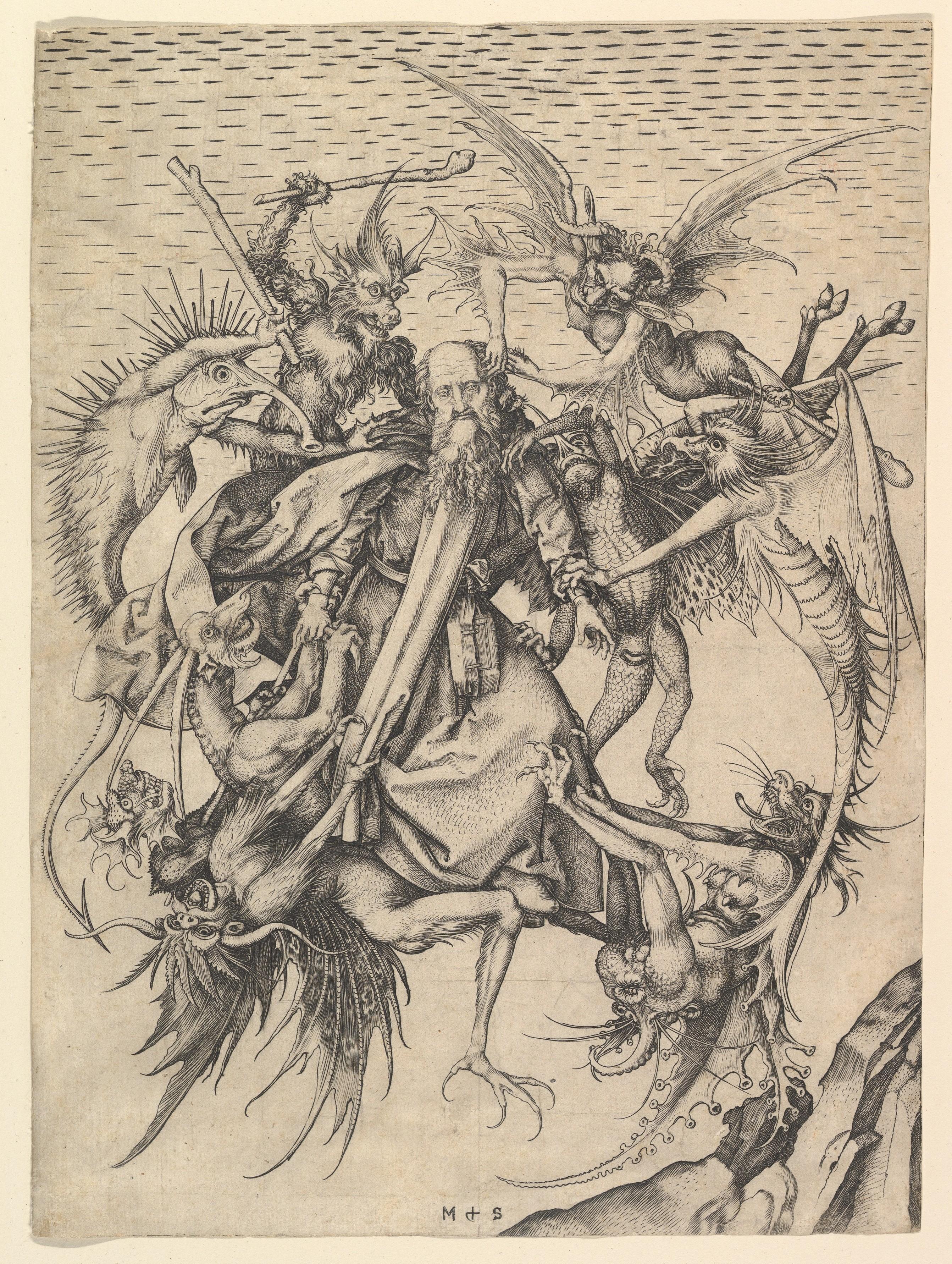
demon
/DĒ-mən/ n., a supernatural entity in religion, mythology, and folklore, evil or malevolent, depending on the culture, from circa 1200, "an evil spirit, malignant supernatural being, an incubus, a devil," from Latin daemon "spirit," from Greek daimōn "deity, divine power; lesser god; guiding spirit, tutelary deity" (sometimes including souls of the dead); "one's genius, lot, or fortune;" from Proto-Indo-European dai-mon- "divider, provider" (of fortunes or destinies), from root da- "to divide."
The malignant sense is because the Greek word was used (with daimonion) in Christian Greek translations and the Vulgate for "god of the heathen, heathen idol" and also for "unclean spirit." Jewish authors earlier had employed the Greek word in this sense, using it to render shedim "lords, idols" in the Septuagint, and Matthew viii.31 has daimones, translated as deofol in Old English, feend or deuil in Middle English. Another Old English word for this was hellcniht, literally "hell-knight."
The usual ancient Greek sense, "supernatural agent or intelligence lower than a god, ministering spirit" is attested in English from 1560s and is sometimes written daemon or daimon for purposes of distinction. Meaning "destructive or hideous person" is from 1610s; as "an evil agency personified" (rum, etc.) from 1712. The Demon of Socrates (late 14th century in English) was a daimonion, a "divine principle or inward oracle." His accusers, and later the Church Fathers, however, represented this otherwise. The Demon Star (1895) is Algol (q.v.).
Wikipedia lists three-hundred four demon names from around the world, and there are almost just as many from the world of fiction. For example, pre-Babylonians called them shedu; in Islamic folklore, they’re called jinns, ifrits, or shayāṭīn; and the Japanese have the ogre-like oni. Christianity has demons as fallen angels called Nephilim; Russian has chorts; and the Algonquian have a tall, antlered, blood-hungry
spirit called a wendigo.
Depending on the culture, a demon might be good — as in Thailand or Japan; bad — as in Christianity; or good or bad — as in voodoo. Christianity doesn't count the devil as a demon; demons are Lucifer's minions who first rose to "popularity" during the Inquisition. Following the Inquisition's lead, which no one expected, accusers and sinners all blamed demons — for being possessed, for infertility, for sudden infant deaths, for impotence, for illnesses, for bad luck, for anything one did to break a religious or other law.
Halloween approacheth, and the veil between realities thins with each light-diminishing day. Best cultivate your relationships with your positive personal demons, and ghost your relationships with your unhealthy, self-harming personal demons.
From A Year with Rilke, October 21 Entry
The Depths of His Own Being, from Borgeby gärd, Sweden, August 12, 1904, Letters to a Young Poet
Only someone who is ready for everything, who excludes nothing, even the most incomprehensible, will live the relationship with another as something alive and will sound the depths of his own being.

A Blue Cow
by Marc Chagall
Be better than yesterday,
learn a new word today,
try to stay out of trouble — at least until tomorrow,
and write when you have the time.
*A nervous wreck.
Oh my god, I think 'Poem In October' is the most beautifully written poem I've ever read; it brought me to tears.
ReplyDelete
ReplyDeleteOnly time for a pouchade
Busy busy- haircuts to undergo,
Agents of Medicare to meet
But I DO wish to cavil with one def.
Dinkytown is not overly unattractive
Or small.
Oh the jerrycummubles of my youth
After the game.
The place had pizzazz
Braw we were then
As we entered the pot house
We might hear the susurrus of
A matriot asking us to sign her petition
For something...a Better World
My duenna calls, rather t'mesis,
From the door
Let's go!
Don't forget your shoes
Love
WARNING: Not 'Poem In October."
ReplyDeleteAs Iclic came out of the house and ascended the hill, he heard a susurrus in the leaves almost at his feet. Strange it was he heard that one in particular amid all the rustlings of a thousand others as the wind was blowing oak leaves about the yard sounding so much the same. But what he saw stopped him just as fast and set his foot mid-stride, him athinkin’ “Is that a rat?” knowin’ full well what a rat looks like and what it doesn’t. "Hmmm, this coat is lighter color. Its tail shorter. Eyes behind slits in squint, not open wide in wonder … Them eyes have no pizzazz about them, offerin’ at the most a pouchade of what it's lookin’ at or scents.” When Iclic's brain screeched, "IT’S MONEY!” And before the dinky rodent could cavil and become further jerrycummumbled; himself a braw man raised by matriots who, in turn, were lovingly guided by compassionate duennas; lacking a suitable tmesis for the situation Iclic stomped on its head with his boot heel and kilt it dead.
Iclic's leaf hun-clue-ting paid off!
Delete