And here is the Wannaskan Almanac with Word-Wednesday for April 15, 2026, the fifteenth Wednesday of the year, the fourth Wednesday of spring, the third Wednesday of April, and the one-hundred-fifth day of the year, with two-hundred sixty days remaining.
Wannaska Phenology Update for April 15, 2026
Purple Martins
Just back from Brazil, Bolivia, and Peru, Progne subis — zhaashaawanibiisens in Anishinaabe — is a passerine bird in the swallow family Hirundinidae. It is the largest swallow in Wannaska or anywhere else in North America. Despite its name, the purple martin is not truly purple. The dark blackish-blue feathers have an iridescent sheen caused by the diffraction of incident light giving them a bright blue to navy blue or deep purple appearance, which may even appear green in color.
Purple martins are considered synanthropic, meaning they have developed an association with humans over time and benefit from living in close proximity to them, where some purple martins have made made a complete transition from nesting in the wild to relying on human-provided nesting sites. The Cherokee hollowed out gourds and hung them on wooden snags and posts in the pre-colonial era. They erected them so that the adult birds would build nests and then feed thousands of insects to their young each day that would otherwise be eating their crops. The Chickasaws and Choctaws hung gourds for martins on stripped saplings near their cabins, as African Americans were doing likewise on long canes on the banks of the Mississippi.

April 15 Fickle Pickle Wednesday Menu Special: Potato Dumpling
April 15 Nordhem Wednesday Lunch: Updated daily, occasionally.
Earth/Moon Almanac for April 15, 2026
Sunrise: 6:33am; Sunset: 8:15pm; 3 minutes, 27 seconds more daylight today
Moonrise: 5:36am; Moonset: 6:22pm, waning crescent, 4% illuminated.
Temperature Almanac for April 15, 2026
Average Record Today
High 52 81 65
Low 29 10 31
The Waste Land
by T. S. Eliot
‘Nam Sibyllam quidem Cumis ego ipse oculis meis vidi in ampulla pendere, et cum illi pueri dicerent: Σίβυλλα τί θέλεις; respondebat illa: ἀποθανεîν θέλω.’
For Ezra Pound
il miglior fabbro.
I. The Burial of the Dead
April is the cruellest month, breeding
Lilacs out of the dead land, mixing
Memory and desire, stirring
Dull roots with spring rain.
Winter kept us warm, covering
Earth in forgetful snow, feeding
A little life with dried tubers.
Summer surprised us, coming over the Starnbergersee
With a shower of rain; we stopped in the colonnade,
And went on in sunlight, into the Hofgarten,
And drank coffee, and talked for an hour.
Bin gar keine Russin, stamm’ aus Litauen, echt deutsch.
And when we were children, staying at the archduke’s,
My cousin’s, he took me out on a sled,
And I was frightened. He said, Marie,
Marie, hold on tight. And down we went.
In the mountains, there you feel free.
I read, much of the night, and go south in the winter.
What are the roots that clutch, what branches grow
Out of this stony rubbish? Son of man,
You cannot say, or guess, for you know only
A heap of broken images, where the sun beats,
And the dead tree gives no shelter, the cricket no relief,
And the dry stone no sound of water. Only
There is shadow under this red rock,
(Come in under the shadow of this red rock),
And I will show you something different from either
Your shadow at morning striding behind you
Or your shadow at evening rising to meet you;
I will show you fear in a handful of dust.
Frisch weht der Wind
Der Heimat zu
Mein Irisch Kind,
Wo weilest du?
‘You gave me hyacinths first a year ago;
‘They called me the hyacinth girl.’
—Yet when we came back, late, from the Hyacinth garden,
Your arms full, and your hair wet, I could not
Speak, and my eyes failed, I was neither
Living nor dead, and I knew nothing,
Looking into the heart of light, the silence.
Oed’ und leer das Meer.
Madame Sosostris, famous clairvoyante,
Had a bad cold, nevertheless
Is known to be the wisest woman in Europe,
With a wicked pack of cards. Here, said she,
Is your card, the drowned Phoenician Sailor,
(Those are pearls that were his eyes. Look!)
Here is Belladonna, the Lady of the Rocks,
The lady of situations.
Here is the man with three staves, and here the Wheel,
And here is the one-eyed merchant, and this card,
Which is blank, is something he carries on his back,
Which I am forbidden to see. I do not find
The Hanged Man. Fear death by water.
I see crowds of people, walking round in a ring.
Thank you. If you see dear Mrs. Equitone,
Tell her I bring the horoscope myself:
One must be so careful these days.
Unreal City,
Under the brown fog of a winter dawn,
A crowd flowed over London Bridge, so many,
I had not thought death had undone so many.
Sighs, short and infrequent, were exhaled,
And each man fixed his eyes before his feet.
Flowed up the hill and down King William Street,
To where Saint Mary Woolnoth kept the hours
With a dead sound on the final stroke of nine.
There I saw one I knew, and stopped him, crying: 'Stetson!
‘You who were with me in the ships at Mylae!
‘That corpse you planted last year in your garden,
‘Has it begun to sprout? Will it bloom this year?
‘Or has the sudden frost disturbed its bed?
‘Oh keep the Dog far hence, that’s friend to men,
‘Or with his nails he’ll dig it up again!
‘You! hypocrite lecteur!—mon semblable,—mon frère!”
April 15 Celebrations from National Day Calendar
- National Tax Day
- American Sign Language Day
- Jackie Robinson Day
- National Rubber Eraser Day
- National Laundry
- National Titanic Remembrance Day
- National Glazed Spiral Ham Day
- National Banana Day
- National Take a Wild Guess Day
- Purple Up! Day
- World Art Day
April 15 Word Pun
Sven renamed my toilet Jim instead of John.
People are more impressed when he tells them he goes to the Jim every morning.
April 15 Word Riddle
What has to be taken before you can get it?*
April 15 The Devil’s Dictionary Word-Pram
TENACITY, n. A certain quality of the human hand in its relation to the coin of the realm. It attains its highest development in the hand of authority and is considered a serviceable equipment for a career in politics. The following illustrative lines were written of a Californian gentleman in high political preferment, who has passed to his accounting:
Of such tenacity his grip
That nothing from his hand can slip.
Well-buttered eels you may o'erwhelm
In tubs of liquid slippery-elm
In vain—from his detaining pinch
They cannot struggle half an inch!
'Tis lucky that he so is planned
That breath he draws not with his hand,
For if he did, so great his greed
He'd draw his last with eager speed.
Nay, that were well, you say. Not so
He'd draw but never let it go!
April 15 Etymology Word of the Week
obey
/ə-BÅ/ v., comply with the command, direction, or request of (a person or a law); submit to the authority of, from circa 1300, obeien, "carry out the commands of (someone); submit to (a command, rule, etc.); be ruled by," from Old French obeir "obey, be obedient, do one's duty" (12th century), from Latin obedire, oboedire "obey, be subject, serve; pay attention to, give ear," literally "listen to," from ob "to" (see ob-) + audire "listen, hear" (from Proto-Indo-European root au- "to perceive"). Same sense development is in hiersumnian, the Old English word for the same thing.
April 15 Historic Events, Literary or Otherwise, from On This Day
- 1729 Johann Sebastian Bach's St Matthew Passion premieres.
- 1738 Serse, an Italian opera by George Frideric Handel premieres.
- 1755 Samuel Johnson's A Dictionary of the English Language is published.
- 1802 William Wordsworth and his sister Dorothy see a "long belt" of daffodils, inspiring the former to pen I Wandered Lonely as a Cloud.
- 1817 The American Asylum, now known as the American School for the Deaf (ASD), is the first permanent US school for the deaf, founded by Rev. Thomas Gallaudet, Dr. Mason Cogswell, and teacher Laurent Clerc in West Hartford, Connecticut.
- 1862 American poet Emily Dickinson first corresponds with author and future literary mentor Thomas Wentworth Higginson.
- 1874 First Impressionist art exhibition opens in Paris, features Claude Monet, Edgar Degas, Pierre-Auguste Renoir, Camille Pissarro and Berthe Morisot.
- 1877 World's first home telephone is installed in Somerville, Massachusetts.
- 1880 Guy de Maupassant's short story masterpiece Boule de Suif (Dumpling) is first published .
- 1924 Rand McNally publishes its first road atlas.
April 15 Author/Artist/Character Birthdays, from On This Day
- 1452 Leonardo da Vinci, Italian painter.
- 1489 Mimar Sinan, Ottoman architect.
- 1618 Anton Stevens, Czech painter.
- 1637 Valentin Molitor, Swiss composer.
- 1651 Domenico Gabrielli, Italian Baroque composer.
- 1682 Jann van Huysum, Dutch painter.
- 1689 Ferdinand Zellbell the elder, Swedish composer.
- 1710 Marie-Anne de Cupis de Camargo, French ballet dancer.
- 1733 Johann Heinrich Zang, German composer.
- 1741 Charles Willson Peale, American painter.
- 1812 Théodore Rousseau, French painter.
- 1827 Julius Tausch, German composer.
- 1829 Mary Harris Thompson, first American woman surgeon.
- 1832 Wilhelm Busch, German poet.
- 1843 Carl Eilhardt, German composer.
- 1843 Henry James, American-British author.
- 1861 Bliss Carman, Canadian poet.
- 1875 Klaziena "Ina" Boudier-Bakker, Dutch playwright and novelist.
- 1878 Robert Walser, Swiss writer.
- 1886 Nikolay Gumilyov, Russian poet.
- 1888 Maximilian Kronberger, German poet.
- 1889 Thomas Hart Benton, American painter and muralist.
- 1891 Väinö Raitio, Finnish composer.
- 1892 Corrie ten Boom, Dutch author.
- 1894 Bessie Smith, American blues singer.
- 1895 Corrado Alvaro, Italian writer.
- 1898 Nini de Boël, Flemish operetta singer.
- 1903 Erich Arendt, German poet and writer.
- 1904 Arshile Gorky, Armenian-American abstract painter.
- 1907 Gerald Abrahams, English author.
- 1911 Jacob Fresco, Dutch architect.
- 1914 John Gregory, British ballet dancer.
- 1915 Elizabeth Catlett, African-American sculptor and print maker.
- 1917 Pietro Grossi, Italian composer.
- 1919 Meriol Trevor, English novelist.
- 1922 Hasrat Jaipuri [Iqbal Hussain], Indian poet.
- 1926 Jurriaan Schrofer, Dutch graphic designer, and sculptor.
- 1931 Tomas Tranströmer, Swedish poet.
- 1933 Boris Strugatsky, Soviet-Russian science fiction author.
- 1936 Héctor Quintanar, Mexican composer.
- 1945 Riken Yamamoto, Japanese architect.
- 1945 Liam O'Flynn, Irish musician.
- 1948 Jan Krzywicki, American classical music composer, conductor.
- 1948 Michael Kamen, American composer.
- 1951 Pavel Zajíček, Czech poet.
- 1957 Jan Pelc, Czech writer.
- 1958 Benjamin Zephaniah, British writer.
- 1958 Dolores Gordon-Smith, British novelist.
- 1966 Cressida Cowell, English children's writer.
- 1981 Seth Wulsin, American artist and sculptor.
Words-I-Looked-Up-This-Week Writer's Challenge
Write a story or pram from the following words:
- ablude: /uh-BLOOD/ v., to differ, be out of keeping. Usually with from.
- approbation: /ap-rə-BĀSH-ən/ n., approval or praise.
- curule: /KYo͞o-ro͞ol/ adj., denoting or relating to the authority exercised by the senior magistrates in ancient Rome, chiefly the consul and praetor, who were entitled to use the sella curulis ("curule seat", a kind of folding chair).
- foremath: /fawr-math/ n., a first mowing; that which is gleaned from a first or prior mowing; what precedes or produces a particular outcome; events that have yet to occur, or are in the process of occurring.
- gaeilgeoir: /GWAYL-gor/ n., a speaker of Irish; an enthusiast for or expert in the Irish language.
- godown: /gō-DOUN/ n., a warehouse.
- quinquennium: /kwiNG-KWE-nē-əm/ n., a period of five years.
- siccar: /SIK-er/ adj., sure, certain, secure, or safe.
- thaumaturgy: /THAW-muh-tur-jee/ n., the performance of miracles or magical feats.
- zyzzyva: /ZIH-zih-vah/ n., a genus of tropical South American weevils that live on palm trees, and "the last word" in the Oxford English Dictionary.
April 15, 2026 Word-Wednesday Feature
Word-Wednesday headquarters had the honor of hosting a person intimately familiar with the famous Facciola /fah-CHOH-lah/ restaurant in Berlin, Germany. While Facciola specializes in the wine served with the meals, Italians serve Italian food made by Italians. They know their pasta, and the honored guest here at Word-Wednesday headquarters gave us a primer on the different kinds of pasta. Pasta is categorized by shape into long strands (spaghetti, linguine), short tubes (penne, rigatoni), shapes (fusilli, farfalle), and stuffed (ravioli, tortellini). Common varieties include ribbons like fettuccine, small soup shapes like orzo, and ridged shapes designed to hold sauce, such as radiatori and pipe rigate. Here's a breakdown of different pasta names by category:
Long Pasta (Pasta Lunga)
Spaghetti: /spuh·GEH·tee/ Long, thin, cylindrical strands.
Linguine: /luhng·GWEE·nee/ Long, flat, narrow ribbons, wider than spaghetti.
Fettuccine: /feh·tuh·CHEE·nee/ Flat, thick ribbons, often used with cream sauces.
Capellini /ka·puh·LEE·nee/ (Angel Hair): Very thin, delicate strands.
Bucatini: /boo·kuh·TEE·nee/ Thick, spaghetti-like tubes with a hole running through the center.
Pappardelle: /paa·paar·DEH·lay/ Very broad, flat pasta ribbons.
Short Pasta (Pasta Corta)
Penne: /PEH·nay/ Cylinder-shaped pieces cut at a diagonal, often ridged ("rigate").
Rigatoni: /RI·guh·tow·nee/ Larger, slightly curved tubes with ridges.
Macaroni: /mak-uh-ROH-nee/ (Elbows) Small, curved, slender tubes.
Fusilli /fyoo·SI·lee//Rotini /row·TEE·nee/: Corkscrew or spiral-shaped twists.
Farfalle: /faar·FAA·lay/ Bow-tie or butterfly-shaped with serrated edges.
Orecchiette: /ow·ray·kee·EH·tay/ "Little ears," small dome-shaped pasta from southern Italy.
Radiatori: /rah-dee-ah-TOH-ree/ Shaped like small, ruffled radiators to catch sauce.
Cavatappi: /kaa·vuh·TAA·pee/ Corkscrew-shaped macaroni.
Trofie: /troh-FYEH/ Thin, twisted pasta, often paired with pesto.
Stuffed or Shaped Pasta
Ravioli: /ra·vee·OW·lee/ Square or round pillows of dough filled with meat, cheese, or vegetables.
Tortellini: /tor·tuh·LEE·nee/ Ring-shaped, stuffed pasta.
Gnocchi: /NYOW·kee/ Small, soft dumplings usually made from potatoes.
Cannelloni: /ka·nuh·LOW·nee/ Large, smooth tubes meant for stuffing and baking.
Small Pasta (Pastina)
Orzo /OR·zow//Risoni: /ree-SOH-nee/ Small pasta shaped like grains of rice.
Stelle /STELL-eh//Stelline: /stell-EE-neh/ Tiny, star-shaped pasta used in soups.
Acini di Pepe: /ASS-ih-nye dee PEH-peh/ Tiny, spherical pasta ("peppercorns").

From A Year with Rilke, April 15 Entry
Survival of the Soul, from Letter to Karl and Elisabeth von der Heydt, November 6, 1914
What more can we accomplish now than the survival of the soul. Harm and decay are not more present than before, perhaps, only more apparent, more visible and measurable. For the harm which humanity has lived daily since the beginning cannot be increased. But there is increasing insight into humanity's capacity for unspeakable harm, and perhaps where it leads. So much in collapse, so much seeking new ways out. Room for what new can happen.
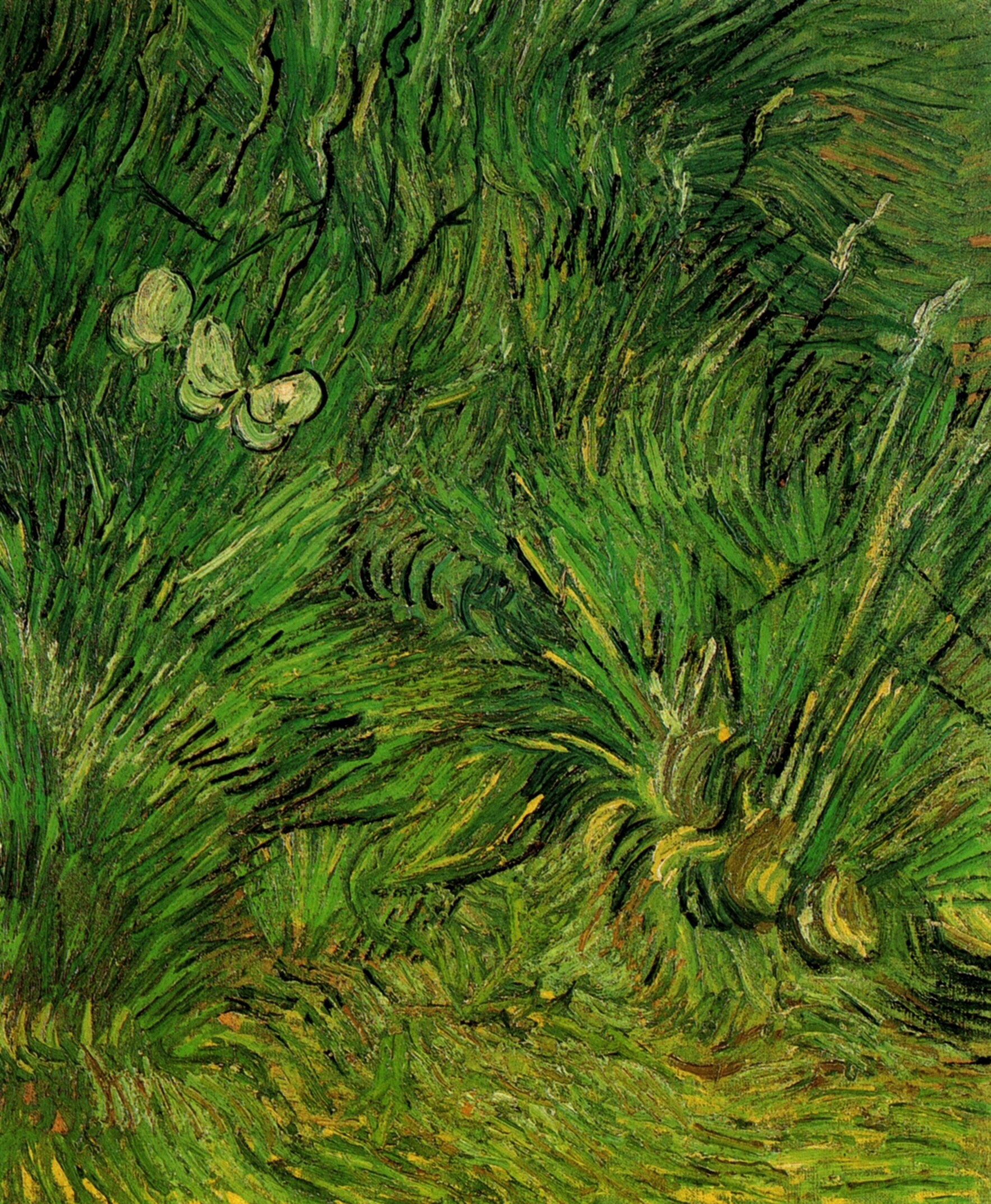
Two White Butterflies
by Vincent van Gogh
Be better than yesterday,
learn a new word today,
try to stay out of trouble — at least until tomorrow,
and write when you have the time.
*a photograph.
ReplyDeleteApril is the cruelest month?
With that I must ablude
I give my approbation to
This month of spring prelude
Crueler far the months before
When winter has its rule
When snow and ice come at the whim
Of Boreal curule
April sees the snow retreat
The crocus is the foremath
I watch for summer lushness
Yes old Sol is on his north path
The Irish have a word for it
Just ask the nearest gaeilgeoir
Tá an tEarrach linn is what she'll say
With lots more phrenolog-lore
I go down next to my godown
To get the seeds and roots
And when I'm sure it's siccar
I pull on my planter's boots
To protect my crop from insects
I perform my thaumaturgy
Asian beetles and zyzzyva
Can't possibly get at me
"Aye, said Sven to no one there. "I’ve been doin' some t'inkin’ bout da upcomin’ foremath an’ vat I’m a needin’ to mebbe fix on da Husqvarna dis ‘ere summer. Last year I suddenly 'ad to buy a new clutch for it an' front wheel rim that wore out. I’m t’inkin’ it’d be smart to take 'vantage of Roseau’s Fleet Store’s thaumaturgy of its 20%-off inventory reduction sale."
ReplyDelete“I know, Sven continued. “Dat Ula vud be dere in spirit anyvay, takin' 'vantage of dem lower den low prices. 'stead
'es off to an adventure sumvere, like da rollin’ stone ‘e is now. ‘is voman fairly pullin’ ‘im outa ’is well-worn an’ comfortable curule seat aginst ‘is will. Sum folk might t’ink ’es seeking approbation frum ‘er, dat ‘es ablude to yust stayin’ ‘ome an’ feedin’ da voodstove mornin’ an’ nigh, but, ‘e ‘es lovin’ it in reality. I’m siccar itz gud fer ‘im to see udder places, visit udder pepple. Vat’s ‘e goin’ to be like in a quinquennium? vell, enny of us?”
While hardly, a gaeilgeoir himself, Sven did enjoy a Guinness Extra Stout now and then and would shout ‘Sláinte!’ hoisting his glass (or bottle) to the sky. Or, given the chance to wreak havoc in lesser men occupying local godowns, he’d shout “Zyzzyva!” and claim he was speaking Czech.
A Formath
ReplyDeleteOne day,
when siccar in their skins,
beyond approbation,
they will ablude from the pack,
to shelve the need for kudos, crowns, and curules.
One-time thaumaturges with words,
from a to zyzzyva,
they will gather each syllable,
each gobbet of gossip and gab
into godowns,
bar and lock them tight,
and enter a quinquennium of quiet.
It will be each
Béarlóir, Frainciseoir, Gaeilgeoir, Síniseoir, Spáinniseoir, Rúisiseoir.
The whole noisy lot of them,