And here is the Wannaskan Almanac with Word-Wednesday for May 6, 2026, the eighteenth Wednesday of the year, the seventh Wednesday of spring, the first Wednesday of May, and the one-hundred-twenty-second day of the year, with two-hundred thirty-nine days remaining. Brought to you by Bead Gypsy Studio, 101 Main Avenue North, Roseau, celebrating mom with 25% off all Chain Necklaces through the month of May.
Wannaska Phenology Update for May 6, 2026
Hummingbird Update
Time to get those feeders out. The Ruby-Throated Hummingbird, Archilochus colubris — nenookaasi in Anishinaabe — is due to arrive in Wannaska any day now.

May 6 Fickle Pickle Wednesday Menu Special: Potato Dumpling
May 6 Nordhem Wednesday Lunch: Updated daily, occasionally.
Earth/Moon Almanac for May 6, 2026
Sunrise: 5:55am; Sunset: 8:46pm; 2 minutes, 59 seconds more daylight today
Moonrise: 1:21am; Moonset: 8:40am, waning gibbous, 81% illuminated.
Temperature Almanac for May 6, 2026
Average Record Today
High 62 86 41
Low 37 16 25
To This May
by W.S. Merwin
They know so much more now about
the heart we are told but the world
still seems to come one at a time
one day one year one season and here
it is spring once more with its birds
nesting in the holes in the walls
its morning finding the first time
its light pretending not to move
always beginning as it goes
May 6 Celebrations from National Day Calendar
- National Beverage Day
- National Crepe Suzette Day
- National Nurses Day
- National Skilled Trades Day
- National Interpreter Appreciation Day
- International No Diet Day
May 6 Word Pun
Smaller babies may be delivered by stork, but the heavier ones need a crane.
May 6 Word Riddle Twofer
What vehicle do jousting knights use?*
a Chairman Joe original
What do you get when a tradwife marries a malewife?**
a Teapoetry original
May 6 The Devil’s Dictionary Word-Pram
ABDICATION, n.
1. An act whereby a sovereign attests his sense of the high temperature of the throne.
Poor Isabella's Dead, whose abdication
Set all tongues wagging in the Spanish nation.
For that performance 'twere unfair to scold her:
She wisely left a throne too hot to hold her.
To History she'll be no royal riddle—
Merely a plain parched pea that jumped the griddle.
—G.J.
2. The surrender of a crown for a cowl, in order to compile the shin-bones and toe-nails of saints. The voluntary renunciation of that of which one has previously been deprived by force. The giving up of a throne for the purpose of enjoying the discomfiture of a successor. For these several definitions we are indebted to Spanish history.
May 6 Etymology Word of the Week
inkling
/INGk-liNG/ n., a slight knowledge or suspicion; a hint, from circa 1400, apparently from the gerund of the Middle English verb inclen "utter in an undertone, hint at, hint" (mid-14th century), which is of unknown origin; perhaps it is related to Old English inca "doubt, suspicion, question, scruple." However the earliest record of the word is as a nyngkiling; and The Middle English Compendium offers that this is not a misdivision of an inkling but rather suggests the word is a nasalized variant of nikking "a hint, slight indication," gerundive of the Middle English verb nikken "to mark (a text) for correction" (mid-15th century), from nik (n.) "a notch, tally".
A farmer, he told me, he did:
"The young of a goat is a kid."
He just shook his head
When I blandly said:
"An inkling's the spawn of a squid."
Peter Anderson, circa 1400
May 6 Historic Events, Literary or Otherwise, from On This Day
- 1432 Renaissance masterpiece The Ghent Altarpiece by Hubert and Jan van Eyck is consecrated.
- 1541 King Henry VIII orders a bible in English be placed in every church in England.
- 1604 Leon VII Spanish poet's first poem is published: La Cocina.
- 1787 First African American Masonic Lodge (African # 459) forms Prince Hall, Boston.
- 1835 James Gordon Bennett, Sr. publishes the first issue of the New York Herald.
- 1837 US blacksmith John Deere creates the first steel plough.
- 1840 World's first adhesive postage stamp, the "Penny Black", is first used in Great Britain.
- 1889 Exposition Universelle (World's Fair) in Paris opens with the recently completed Eiffel Tower serving as the entrance arch; the lifts in the tower are not ready, so intrepid visitors have to climb 1,710 steps to reach the top.
- 1940 Pulitzer prize awarded to John Steinbeck for The Grapes of Wrath.
- 1963 Pulitzer Prize awarded to Barbara Tuchman.
- 1964 Joe Orton's play Entertaining Mr Sloan premieres.
- 1974 American composer Roger Sessions receives special Pulitzer Prize.
- 2024 Pulitzer Prize for Fiction won by Jayne Anne Phillips.
May 6 Author/Artist/Character Birthdays, from On This Day
- 1581 Frans Francken the Younger, Flemish painter.
- 1606 Lorenzo Lippi [Perlone Zipoli], Italian poet and painter.
- 1668 Alain-René Lesage, French author.
- 1759 François Andrieux, French playwright.
- 1786 Ludwig Borne [Loeb Baruch], German-Jewish writer.
- 1790 Wilhelm Würfel, Bohemian pianist, conductor, teacher, and composer.
- 1798 Joseph Welland, Irish architect.
- 1800 Ferdinand Marcucci, Italian harpist and composer.
- 1802 Wilhelm Schirmer, German landscape artist.
- 1809 William Walker, American composer.
- 1829 Phoebe Ann Coffin Hanaford, first female ordained minister in New England.
- 1838 Alfred Pease, American composer.
- 1849 Wyatt Eaton, Canadian-American artist.
- 1858 Georges Hüe, French composer.
- 1859 Willem Kloos, Dutch poet.
- 1868 Gaston Leroux, French writer.
- 1870 John T. McCutcheon, American cartoonist.
- 1871 August Reusner, German composer.
- 1871 Christian Morgenstern, German poet.
- 1879 Bedřich Hrozný, Czech orientalist and linguist.
- 1882 Georgi Atanasov, Bulgarian composer.
- 1883 José Ortega y Gasset, Spanish philosopher and author.
- 1883 Victor Neuberg, English poet.
- 1894 Filip Lazar, Romanian composer.
- 1895 Júlio César de Mello e Souza, Brazilian writer.
- 1897 Paul Alverdes, German writer.
- 1904 Harry Martinson, Swedish novelist and poet.
- 1906 Enrique Laguerre, Puerto Rican writer.
- 1908 Necil Kazım Akses, Turkish classical composer.
- 1912 B. Roest Crollius, Dutch painter and writer.
- 1913 Gyula David, Hungarian composer.
- 1915 George Perle, American composer.
- 1915 May Henriquez-Alvarez, Curacao Dutch sculptor.
- 1918 Godfrey Ridout, Canadian composer.
- 1921 Erich Fried, Austrian-British writer.
- 1922 Alan Ross, British poet.
- 1923 Chih Ree Sun, Chinese-American physicist and poet.
- 1924 Mimi Benzell, American operatic soprano.
- 1926 Marguerite Piazza, American operatic soprano.
- 1931 Hasaan Ibn Ali [William Henry Langford, Jr], American jazz pianist and composer.
- 1932 Günther Hauk, German composer.
- 1940 Henry Habibe, Arubian poet.
- 1941 Ghena Dimitrova, Bulgarian operatic soprano.
- 1943 James Turrell, American artist.
- 1946 David Avshalomov, American classical composer.
- 1947 Sandra Fisher, American painter.
- 1960 Phyllis Treigle, American operatic soprano.
- 1963 Alessandra Ferri, Italian ballerina.
- 1965 Nathalie Stutzmann (née Dupuy), French concert contralto.
- 1970 Alan Monaghan, Irish novelist.
- 1971 Declan de Barram, Irish writer.
Words-I-Looked-Up-This-Week Writer's Challenge
Write a story or pram from the following words:
- acescent: /uh-SESS-uhnt/ adj., tending to turn acid or sour; acidic; sour.
- Beltane: /BEL-tān/ n., an ancient Celtic festival celebrated on May first (or November first in the Southern Hemisphere) that marks the beginning of summer, fertility, and the "light" half of the year.
- cincture: /SING(kt)-SHər/ n., girdle or belt; a ring at either end of a column shaft.
- diablerie: /dē-A-blə-rē/ n., reckless mischief; charismatic wildness.
- fadiddy: /FAD-ee-dee/ adj., describes someone with strong, often irrational, and transitory whims, typically concerning food or habits.
- gamahe: /GAM-uh-hay/ n., a natural object bearing markings resembling pictorial or ornamental figures, and in consequence sometimes credited with talismanic or other magical properties.
- invidia: /in-VID-ee-ah/ n., a Latin term for envy, jealousy, or ill-will, typically defined as the painful, spiteful feeling caused by seeing another person's success or advantages.
- jit: /jit/ n., a style of dance music popular in Zimbabwe.
- kenopsia: /ken-OP-see-uh/ n., the eerie, melancholic atmosphere of a place that is usually bustling with life but is now abandoned and quiet.
- lulz: /ləlz/ n., fun, laughter, or amusement, especially that derived at another's expense.
May 6, 2026 Word-Wednesday Feature
Deadly Sins
/sin/ n., an immoral act considered to be a transgression against divine law; an act regarded as a serious or regrettable fault, offense, or omission, from Middle English sinne, from Old English synn, syn "violation of divine law, offense against God; moral wrongdoing," also "injury, mischief; enmity, feud; guilt, crime, misdeed," from Proto-Germanic sundiō "sin" (source also of Old Saxon sundia, Old Frisian sende, Middle Dutch sonde, Dutch zonde, German Sünde "sin, transgression, trespass, offense," extended forms).
According to Watkins, etc., the notion is probably ultimately "it is true," i.e. "the sin is real" (compare Gothic sonjis, Old Norse sannr "true"), from Proto-Indo-European snt-ya-, a collective form from es-ont- "becoming," present participle of the root es- "to be." The semantic development would be via the notion of "to be truly the one (who is guilty)," as in Old Norse phrase verð sannr at "be found guilty of," and the use of the phrase "it is being" in Hittite confessional formula. The same process probably yielded the Latin word sons (genitive sontis) "guilty, criminal" from present participle of sum, esse "to be, that which is." Some etymologists believe the Germanic word was an early borrowing directly from the Latin genitive. Also see sooth.
The details of the purely theological definition are much contested. Sin-eater is attested from 1680s, "one who, for pay, takes on the sins of a deceased person," typically by eating certain food in the presence of the corpse. To live in sin "cohabit without marriage" is from 1838; the phrase was used since Middle English in a more general sense (to sin with has been "commit fornication or adultery with" since circa 1200). Ice hockey slang sin bin "penalty box" is attested from 1950.
"Sin is behovely, but all shall be well, and all shall be well, and all manner of things shall be well." [Juliana of Norwich]
Research shows that one-third of U.S. adults say they attend religious services in person at least once a month, including twenty-five per cent who report going at least once a week. One might assume that religious teaching and word-meanings might also be on the decline, so this week Word-Wednesday examines the word "sin" and related definitions. Christian churches, particularly the Catholic Church, have long been interested in teachings about the most deadly of those sins - popularly known as seven in number - featured prominently in Dante's Divine Comedy, in the first section that addresses hell. Interestingly, a Roman named Tertullian (155-220 A.D.) — writing in Greek — was the first to classify sins by category: physical appetites, emotional moods, and mental thoughts, for which each category had many entries. Then cam Evagrius Ponticus, an ascetic monk also writing in Greek, who refined the notion of sin into categories of temptation — eight in number:
- gluttony, Greek: gastrimargia
- sexual lust: Greek: porneia
- love of money: Greek: philargyria
- sadness: Greek: lypē
- anger: Greek: orgē
- akēdia: Greek: akēdia
- vainglory: Greek: kenodoxia
- pride: Greek: hyperēphania
Two centuries later in 590 AD, Pope Gregory the First revised this list to form the more commonly known Seven Deadly Sins, where Pope Gregory combined acedia (despondency) with tristitia (sorrow), calling the combination the sin of sloth; combined vainglory with pride; and added envy to complete the list. A secular author recently suggested an eighth deadly sin as the newest form of human debasement: Wi-Fi.

From A Year with Rilke, May 6 Entry
Departure of the Prodigal Son, from New Prams
To go forth now
from all the entanglement
that is ours and yet not ours,
that, like the water in an old well,
reflects us in fragments, distorts what we are.
From all that clings like burrs and brambles—
to go forth
and see for once, close up, afresh,
what we had ceased to see—
so familiar it had become.
To glimpse how vast and how impersonal
is the suffering that filled your childhood.
Yes, to go forth, hand pulling away from hand.
Go forth to what? To uncertainty,
to a country with no connections to us
and indifferent to the dramas of our life.
What drives you to go forth? Impatience, instinct,
a dark need, the incapacity to understand.
To bow to all this.
To let go—
even if you have to die alone.
Is this the start of a new life?
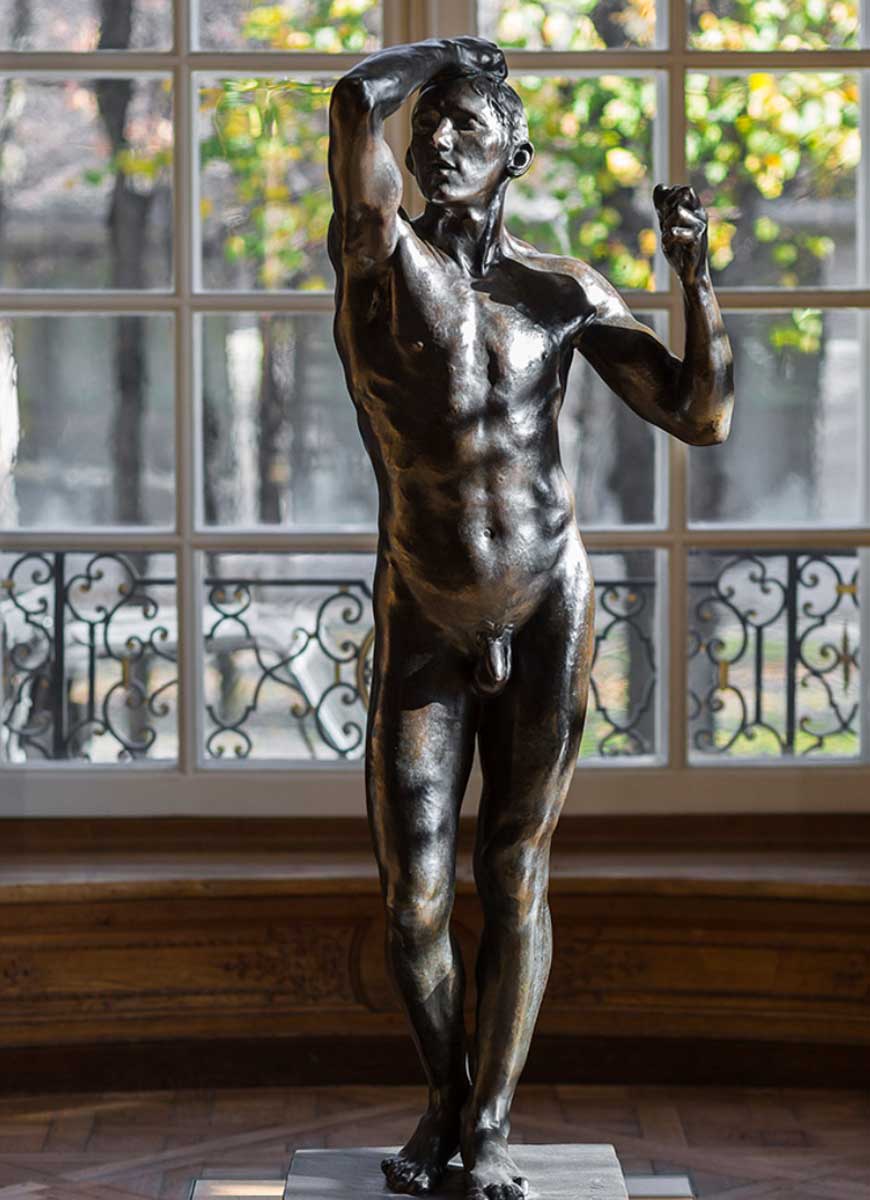
The Age of Bronze
by Auguste Rodin
Be better than yesterday,
learn a new word today,
try to stay out of trouble — at least until tomorrow,
and write when you have the time.
*The Chevy Impaler.
**Nothing to talk about during dinner.
In fairness, they probably swap recipes. On bad days, though, I’m afraid that they might fight over who’s doing what - and maybe over who’s wearing the apron.
ReplyDelete
ReplyDeleteMy soul curls up and turns acescent
When I look outside my door
So this is Beltane? I don't think
These freezing temps and clouds that lour
I put more logs into the stove
I tighten up my cincture
My typical diablerie
Has lost its sky blue tincture
If it fails to warm up soon
I'll fear I'll turn fadiddy
And end up doing awful deeds
Like Judas or P. Diddy
Just yesterday we got more snow
Inuksuks all were lost
Nor could I find the gamahe
Covered in thick frost
It's ninety down in Mesa
That heats up my invidia
I'm scrolling for the cheapest flight
I'm going south immedia
I found a flight to Africa
To Zimbabwe I did flit
Once arrived I dropped my duds
And gaily did the jit
There was a lulzless atmosphere
Of drear kenopsia
The winter there had just begun
The sun was saying see ya
Kenopsia
ReplyDeleteOur so-called casual work lunch, and
can I tell you what your look meant?
Flames sparked.
Over chicken soup,
the fires of Beltane
singed the fringe of my skirt.
And then, like nothing happened,
we ate the last of the French fries,
then went back to work.
I don’t know about you,
but back at my desk, I daydreamed.
Got lost in some faddidy foolishness
where first I jitted around you
with scarves.
And somehow ended up on a couch,
my mouth open as,
one by one, I dripped with
the acescent sweetness
of what I might call summer’s grapes.
You were just loosening the cinture around my waist
when, in the middle of my fantasy, Olivia walked by.
The intensity of her invidia was obvious.
I know she knows something.
The other day in the ladies room
I heard her lulzing with Morgan
about picking up the scent of our slow burn.
I’m home alone in my apartment and lonely.
I want to tell you more.
About how I watched myself snared in diablerie.
And how I threw a ribboned Maypole onto a bonfire for burning.
But you are not here,
and you’ll never read this.
What might be, is as real as the etchings on the gamahe
I keep on the shelf above my kitchen counters.